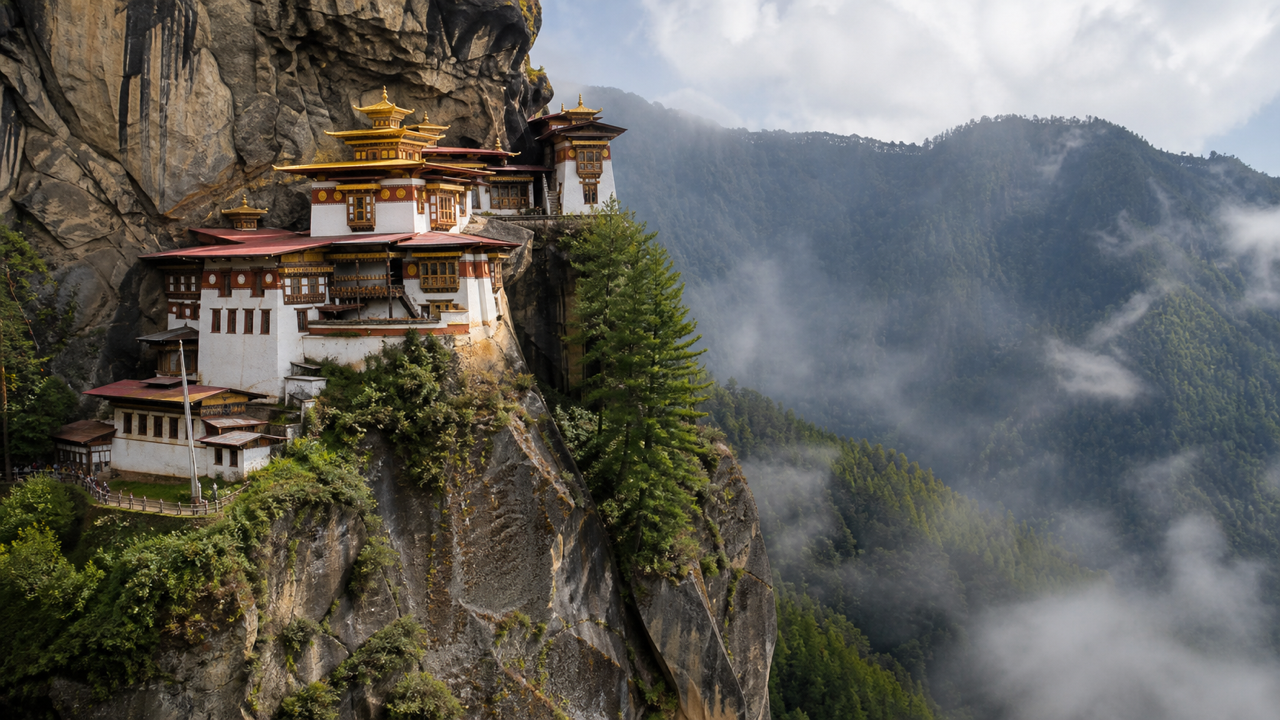
Bhutan charges a nightly fee that most countries do not. The Department of Tourism sets out the visa, the fee and the guide rule on one FAQ page.
Visa
The department states: “Visitors of all nationalities, except those from India, require a visa before entering Bhutan.” Visitors from Bangladesh and Maldives can apply on arrival. Everyone else applies before they travel, and the department says “a correctly input visa application can take up to five days to process.” Do not leave it to the last minute.
The application costs “a one-off fee of US$40 for the processing of your application,” paid alongside the Sustainable Development Fee (SDF) rather than separately.
The nightly fee
The SDF is charged per night in three bands: “The SDF is USD 100 per night for adults from all countries except for India. Children aged between 6 years and who have not yet turned 12 are eligible to pay USD 50 per night. Children who have not yet turned 6 years old do not have to pay any SDF.”
Two adults and two children aged 7 and 4 pay US$250 a night rather than US$400. Both cutoffs are birthdays: the concession runs from the sixth birthday until the twelfth, so a child who turns 12 during the trip moves up a band.
Indian nationals pay less, in local currency, with the same three bands: “The SDF for Indian nationals (showing a valid Indian passport or Voter ID card) is Nu. 1,200 (or the equivalent amount in Indian rupees) per person, per night. Children aged between 6 years and who have not yet turned 12 are eligible to pay Nu./INR 600 per night. Children who have not yet turned 6 years old do not have to pay any SDF.”
Where the money goes
The fee “is collected by the national exchequer and funds are allocated to various projects that create long-term, sustainable opportunities for the Bhutanese people, through free healthcare, education and training, upskilling the tourism and hospitality industry, improved infrastructure, environmental preservation and conservation, cultural preservation programmes and initiatives that support local businesses and economies.”
Refunds
“The SDF will be refunded by the Department of Immigration for any cancelled or shortened trips; any bank charges will be deducted from the total refunded.” Refund requests go through the visa portal and are processed after you leave the country. The department also says “the SDF will be refunded for any nights that are not spent in the kingdom.”
How long you can stay
“The visa allows you to remain in Bhutan for a maximum of 90 days from the date of entry.” The department sets no minimum. The fee is charged per night and refunded for nights not spent, so nothing in the published mechanics fixes a trip length. What the licensed operators sell shows how long Bhutan trips tend to run, and it is worth a look before you fix dates.
A guide with you at all times
This is a requirement: “It is mandatory to be accompanied by a guide at all times in Bhutan.” There is no version of the trip you assemble from parts after you land, so the guided itinerary is the product itself, and Bhutan is sold as multi-day guided trips for that reason.
Insurance and plugs
Travel insurance, once mandatory, is not now: “The requirement for mandatory travel insurance was lifted on April 23, 2024.” The department still recommends carrying it.
The SDF is the largest line in most Bhutan budgets, and the government refunds it itself, so trip-cancellation cover does less here than on a trip of the same price elsewhere. It does not refund your flights or what your tour operator has already committed, which is where a policy earns its cost, if it earns it at all. Bhutan is a guided, prepaid trip in a country with limited medical evacuation options, so the cover that matters is medical and evacuation. SafetyWing sells that as a standalone policy if your existing cards or policies do not reach this far.
On plugs, the department advises bringing adaptors for British (type G), European (type C) and Indian (type D) sockets: “it’s a good idea to bring adaptors for all three.”
Corrections
18 September 2026. This page previously carried a section headed “No children’s fee, age cutoff, or minimum trip length given”. It said the Department of Tourism publishes no children’s rate, no age cutoff, no age-based exemption, and nothing about what the fee funds. Only the trip-length claim was true.
The rest is on the page cited at the foot of this guide, and the children’s rates sit in the same paragraph as the US$100 figure the old version quoted. The quote was cut after its first sentence and the next two sentences were then described as missing. A family reading it was told to ask a tour operator what their children would pay, when the answer was US$50 for a child aged six to eleven and nothing below six.
Recorded rather than quietly edited, because sending a family off to confirm a discount that the source already grants them is a costly kind of wrong.
Guided Bhutan itineraries, which the rule requires rather than suggests (affiliate link)
SafetyWing's Nomad Insurance Essential, travel medical cover Bhutan recommends without requiring (affiliate link)