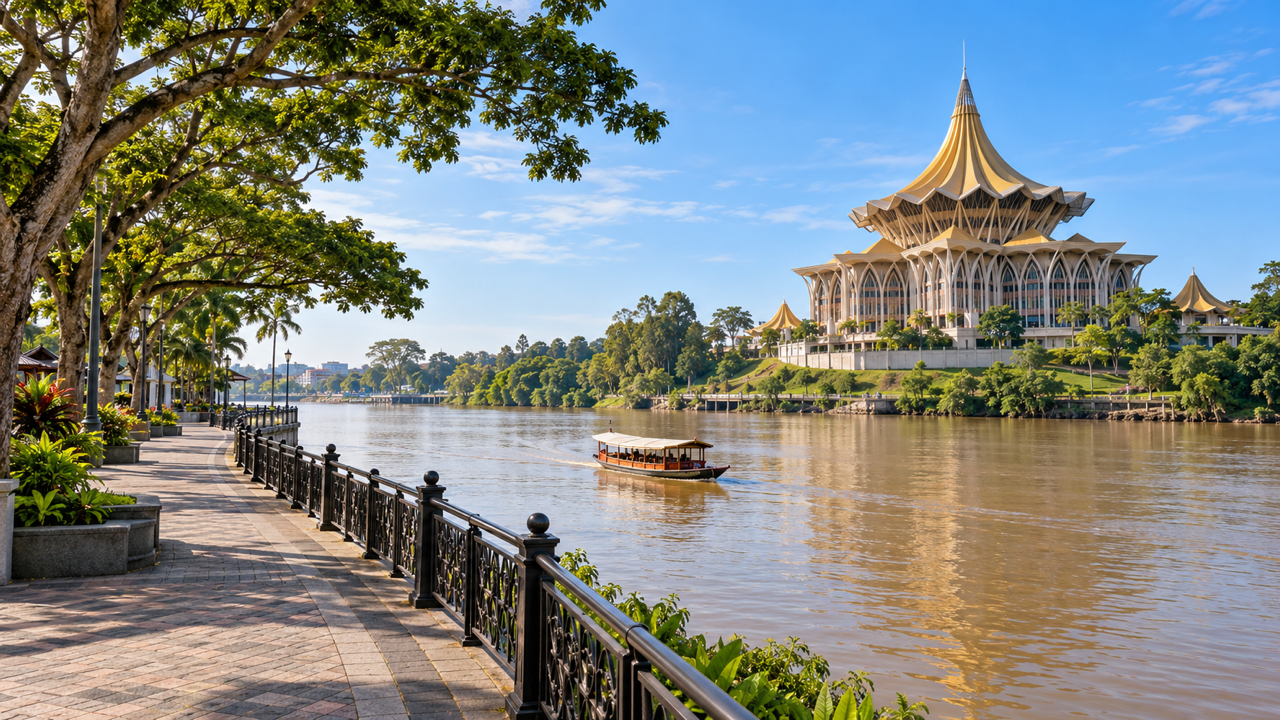
Malaysia’s federal second-home programme makes buying a house compulsory, and the house cannot be sold for ten years. Sarawak, on Borneo, runs its own programme under its own ministry, and on the house, which matters most to a retiree, it does the opposite.
Everything below is from the SMM2H Application Guidelines published by Sarawak’s Ministry of Tourism, Creative Industry and Performing Arts, dated May 2025, and read on 23 September 2026.
⚠️ The programme’s website still carries an older FAQ with the wrong deposit. Read on the same day, it gives RM150,000 for an individual, age bands from 30 to 50, and a reference to the pandemic. The May 2025 guidelines, linked from the same site, require RM500,000. Budgeting from the FAQ would set aside less than a third of the deposit. This page follows the guidelines.
How it differs from the federal programme
| Sarawak SMM2H | Federal MM2H, Silver tier | |
|---|---|---|
| Minimum age | 30 | 25 |
| Deposit | RM500,000, in a Sarawak panel bank | US$150,000, in a licensed Malaysian bank |
| Must keep on deposit | At least RM250,000 | Up to half may be withdrawn for set purposes |
| Home purchase | Optional | Compulsory, RM600,000 or more, unsellable for ten years |
| Time in the country | At least 30 days a year in Sarawak | 90 days a year, with the age question the ministry’s pages disagree on |
| Pass | 5 years plus 5 | 5 years, renewable |
| Work | Part time only, in approved sectors | Not allowed |
The federal terms are in our guide to the federal MM2H tiers.
Who can apply, and who must vouch for you
Citizens of countries with diplomatic relations with Malaysia, excluding Israel and North Korea, can apply from age 30. Applications go through Sarawak’s own online system. Every applicant must be bonded by a sponsor, who is either:
- an immediate family member, such as a spouse, parent, child or sibling, who comes from and lives in Sarawak; or
- an SMM2H licensed agent registered in Sarawak.
A personal sponsor may sponsor only one applicant at a time. The sponsor signs a security or personal bond as guarantor, at a rate that varies by the applicant’s nationality, stamped at the Sarawak office of the Inland Revenue Board.
The one-time processing fee is RM5,000, paid to the ministry and not refundable.
The money
The fixed deposit is mandatory: RM500,000 for the main applicant, placed with a panel bank in Sarawak. To open it, ask the ministry for a support letter, which needs a copy of your passport’s entry stamp into Sarawak.
You also show financial capability in one of three ways:
- a pension of RM10,000 a month, or RM15,000 with a dependant, shown by a pension letter and the latest three months of payments
- offshore income from employment at the same levels, shown by payslips and bank statements
- savings of RM100,000, or RM200,000 with a dependant, across the latest three months, for applicants with neither of the above; the guidelines make this subject to panel approval
After approval, you must keep at least RM250,000 in the programme’s fixed deposit. After one year you may withdraw up to half of it, but only to buy a house or a car in Sarawak, or for medical expenses or children’s education in Sarawak.
The house is your choice
The guidelines state that property purchase is optional for all applicants. If you do buy, the minimum value for a foreign purchaser is RM600,000 in the Kuching Division and RM500,000 in other divisions, under Sarawak’s land rules for foreign acquisition.
The federal route asks you to commit to a home in a city before you know it. In Sarawak you can rent in Kuching for as long as you like and buy later, or never.
Health: checked in Sarawak, insured locally
The medical report must be done at a registered medical facility in Sarawak and endorsed by a government doctor there. An overseas check-up has to be redone in Sarawak before you claim the pass.
The guidelines require a copy of local medical insurance covering the whole pass. On the main applicant’s checklist that line applies to applicants below 60 years old. The checklist for accompanying family has no such limit. If you are over 60 and applying as the main participant, confirm with the ministry which applies to you before assuming you are exempt.
Staying, renewing and leaving
Main participants must stay at least 30 days every year in Sarawak, which the guidelines make a condition for considering an extension or renewal.
The pass is granted as 5 plus 5 years. The second five years is an extension through the Immigration Department in Sarawak, with a new medical report and your latest income or pension evidence. After ten years, continuing means a new application, submitted six months before the pass expires.
Participants may not work full time. They may work part time, up to 20 hours a week, in approved professional sectors (education, banking and securities, manufacturing and medical). They may hold up to 49% of a joint venture with a local partner with at least RM250,000 in paid-up capital. All of this is subject to state approval.
To leave the programme, terminate the pass at the Immigration Department in Sarawak, then apply to the ministry to release the fixed deposit, with the immigration termination letter.
Who Sarawak suits
Sarawak suits someone who wants Malaysian residence without buying property, can place RM500,000 and keep half of it there, and would rather spend time in Kuching than Kuala Lumpur. If you expect to be based on the peninsula, read the federal terms instead: the 30 days a year, the panel banks, the medical checks and the sponsor are all set in Sarawak. For the wider comparison with Thailand, the Philippines and Indonesia, see our planning page.
Sabah runs its own programme too, with three tiers and a compulsory home; see Sabah’s MM2H and what Kota Kinabalu asks of you.