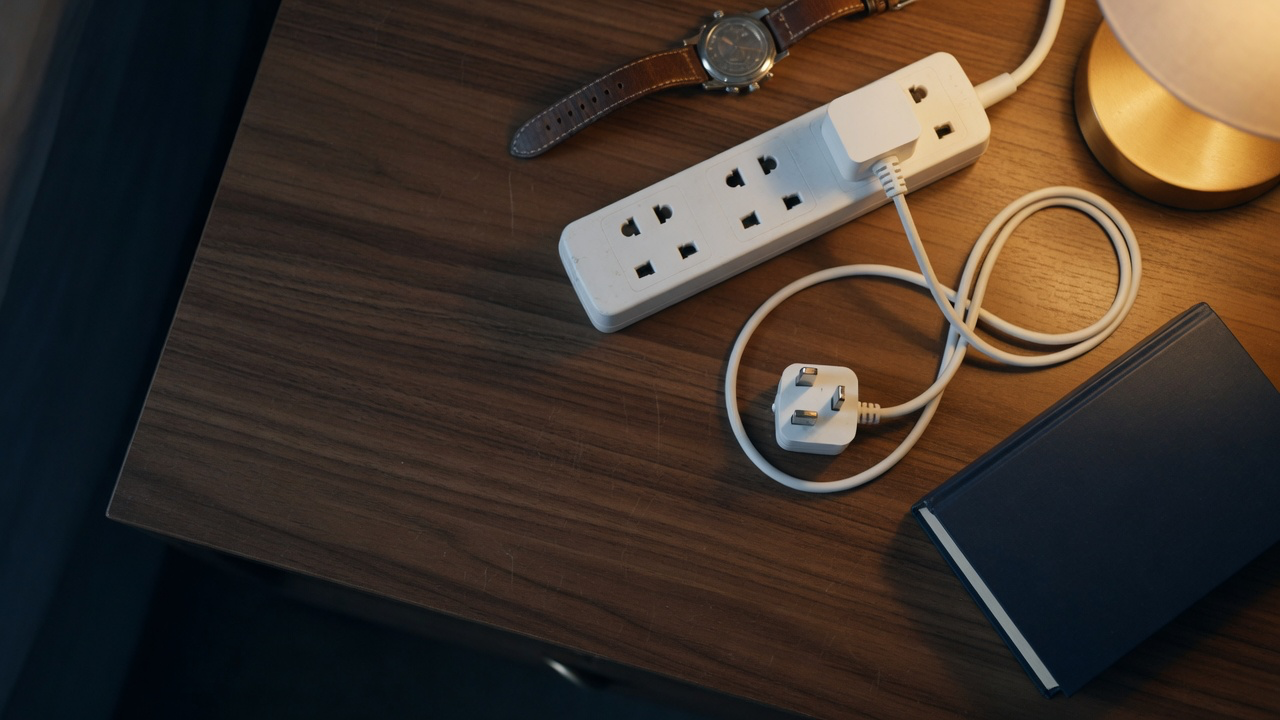
People solve travel power badly because they start with the plug shape, which matters least.
Plugs and voltage
Asia mixes flat two-pin, angled three-pin, round two-pin and the large British-style three-pin, sometimes in neighbouring countries and occasionally in the same hotel. A universal adapter handles all of them and costs very little.
An adapter changes the shape of the hole, not the voltage. Almost everything you carry (phone, laptop, camera, e-reader) runs on a switching supply that accepts the full global range, so voltage rarely matters. Check anything with a heating element or a motor: hair tools, travel kettles, some shavers. The check is the small print on the brick itself.
Power banks and airlines
A lithium power bank travels in the cabin, never in checked baggage. The rule is consistent across nearly all airlines and jurisdictions. A battery fire in the hold is a much worse problem than one in a cabin where someone can deal with it.
Two practical consequences:
- If your bag is gate-checked because the overhead bins filled, the power bank has to come out and travel with you. Keep it where you can reach it.
- Capacity limits are in watt-hours and are enforced against the printed rating. A bank with no legible rating can be refused because there is no way to assess it. Buy ones with the number printed on them, and retire one whose label has rubbed off.
Several airlines have also tightened rules on using a power bank in flight, and a number now want it visible rather than in an overhead bin. Assume the rules keep tightening. Check your carrier, and do not rely on what was true last year.
What is worth carrying
One multi-port charger with enough wattage to run your laptop. Modern gallium-nitride chargers are small enough that one unit replaces the laptop brick and every phone plug. Hotel desks in Asia are often one socket behind a bed frame, and a single plug is what makes that workable.
Two cables, not one. Cables fail, always at the least convenient moment, and they are the cheapest thing to duplicate.
A power bank sized to your day, not your trip. The largest one sold is tempting. You need enough to get a phone through a long day of navigation and photos with margin. A bank heavy enough to leave in the hotel is not helping you.
Whichever brand you buy, check that the capacity is printed on the casing in watt-hours, the number an agent asks for at a gate. Ugreen print it. Plenty of cheaper brands print only milliamp-hours, which is a different figure and not the one you will be asked for.