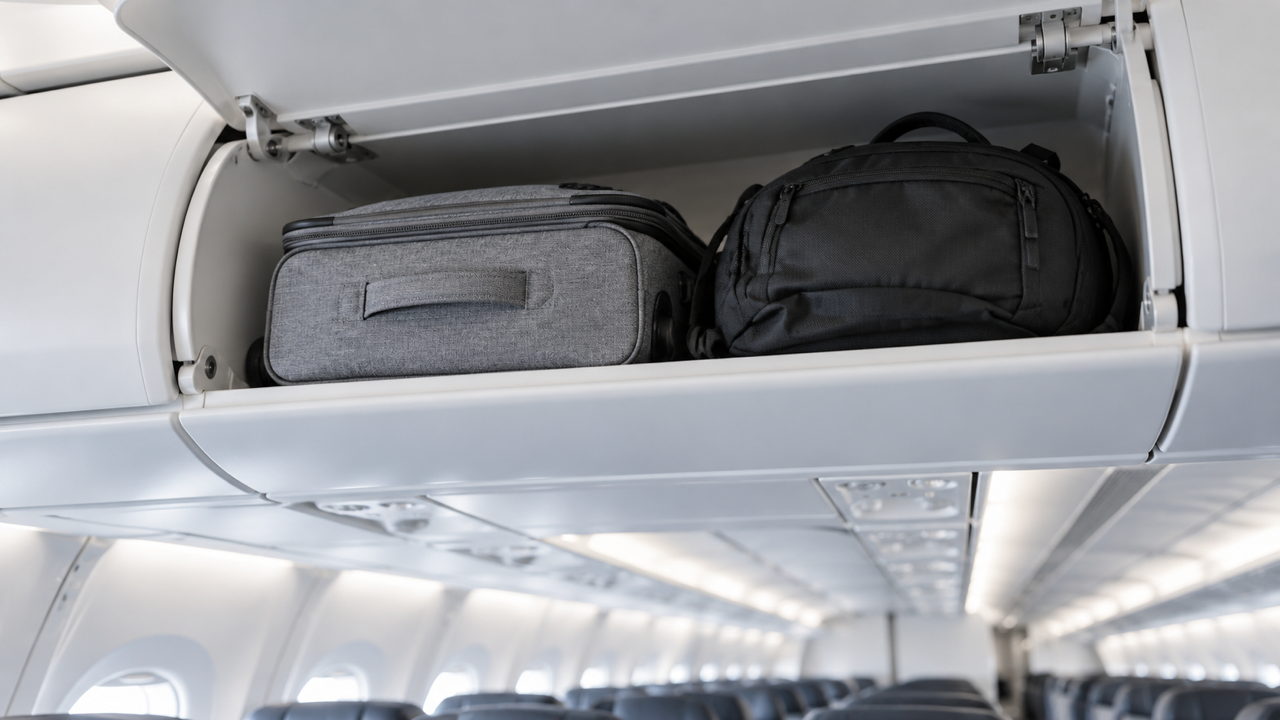
Most people flying low-cost carriers in Asia carry one number in their head, usually seven kilograms. The four carriers below apply it to different things, and Cebu Pacific raised its limit on 15 September 2026.
Size: the boxes all add up to 115cm
- AirAsia: 56cm x 36cm x 23cm
- Cebu Pacific: 56cm x 36cm x 23cm
- IndiGo: 55cm x 35cm x 25cm
- Scoot: 54cm x 38cm x 23cm
Each adds up to 115. Scoot caps “total linear dimensions” at 115cm, and IndiGo allows “one handbag up to 7 kgs and 115 cms (L+W+H)”. AirAsia and Cebu Pacific publish only the box, and their boxes reach the same total.
The boxes are not interchangeable, which matters before you buy luggage. A bag 56cm tall clears AirAsia and Cebu Pacific and fails Scoot, whose limit in that dimension is 54cm.
Weight runs from 7kg to 10kg
| Carrier | Cabin allowance | What the number covers |
|---|---|---|
| AirAsia | 7kg | Cabin bag and personal item, combined |
| Cebgo (DG) | 7kg | Cabin bag and personal item, combined |
| Cebu Pacific (5J) | 10kg since 15 September 2026 | Cabin bag and personal item, combined |
| Scoot (Economy) | 10kg | Cabin bag and personal item, combined |
| IndiGo | 7kg, plus 3kg | Bag alone, personal article counted separately |
Scoot’s baggage page markets its 10kg as “3kg more than most low-cost carriers”. A carrier competing on cabin allowance is telling you what it takes the regional norm to be, and that norm is seven.
The personal item is where the seven-kilo rule bites
The third column of the table matters most.
AirAsia says: “You are allowed to bring onboard two (2) pieces of bag as part of your cabin baggage allowance with the total weight of both items not exceeding 7kg.” The laptop bag under the seat is inside the seven. So is the camera bag, and so is the duty-free you bought airside.
IndiGo builds the allowance the other way round. Seven kilograms is for the handbag alone, and the rules add “one personal article, such as ladies’ purse or a small bag containing laptop, not weighing more than 3 kgs”. A traveller who packs seven kilograms of bag plus a three-kilo laptop bag is correct on IndiGo and three kilograms over on AirAsia, having followed the same number both times.
Cebu Pacific states the combined form in its own FAQ: one hand carry item and one personal item, “with a combined weight of up to 10 kg for Cebu Pacific (5J) flights and 7 kg for Cebgo (DG) flights”.
Cebu Pacific changed on 15 September, on half its flights
The 10kg figure applies “to 5J flights departing September 15, 2026 onwards, regardless of when the flight was booked”, so a ticket bought in June travels under the new allowance. Cebgo, the regional subsidiary, stays at 7kg. Cebu Pacific says Cebgo “uses smaller aircraft with limited cabin storage”.
One itinerary sold under one brand can therefore carry two cabin allowances. The flight number tells you which: “If your flight number starts with 5J, you’re flying with Cebu Pacific and your combined hand carry weight limit is 10kg. If it starts with DG, you’re flying with Cebgo and your combined hand carry weight limit is 7kg.”
Check this on a Manila connection, where a long sector on 5J and a short island hop on DG are an ordinary way to build a trip.
AirAsia closed the airport-counter route in April
Checked 25 September 2026. Media speculation about AirAsia’s finances has been heavy this month. On 2 September the group announced the “temporary suspension of certain routes, such as Kuala Lumpur to Sydney and Delhi”, and on 18 September it said there is “no question about our commitment to business continuity” (AirAsia Newsroom). We make no prediction either way. If you book an AirAsia flight months ahead, pay by credit card and keep the date of the first statement that shows the fare. What a cancellation or an airline shutdown means for your ticket explains why.
AirAsia sells extra cabin weight as Xtra Carry-On, and the way to buy it changed earlier in the year. Effective 13 April 2026, Xtra Carry-On “cannot be purchased at airport counters and must be pre-book on AirAsia MOVE website/app up to 2 hours before departure”. At the counter the most you can now add is 3kg, to a ceiling of 10kg. Buying the extra weight on AirAsia’s own site is now the only way to get more than 3kg, and the airline set that rule.
The gate is a worse place to solve this than it used to be. The two-hour cutoff closes the app option while you are still in the taxi.
Firefly uses the same box and puts 10kg in the hold
Firefly, the regional airline in the same group as Malaysia Airlines, is not a low-cost carrier and is not in the table above. Its cabin rule has the same shape, and out of Kuala Lumpur it is the obvious comparison with AirAsia.
Firefly’s add-ons page allows “another extra 7kg on board”, in a bag within “56cm (length) x 36cm (width) x 23cm (depth)”, which is AirAsia’s box and the same 115cm total. Its fee table then says: “One free hand-carry baggage of 7kg is allowed. Overweight, over-sized and extra hand baggage will be checked in as checked baggage and a fee imposed per piece.” Neither page says whether a laptop bag or handbag sits inside the 7kg, so pack as though it does, as you would on AirAsia.
The difference is in the hold. Firefly says “Each traveller will receive 10kg checked baggage for their journey at no charge”, under the heading “Free 10kg checked baggage for all”. If your bag weighs between 7kg and 10kg, that changes the sum. On a route both airlines fly, compare the AirAsia fare plus Xtra Carry-On or a checked bag with a Firefly fare, which already includes 10kg in the hold. If everything you carry fits in 7kg, the free bag is worth nothing to you and the cheaper fare wins.
The expensive mistake is turning up at the gate with a second bag. Firefly’s fee table charges excess hand baggage per piece at the boarding gate: MYR 47.17 on a domestic turboprop flight and MYR 188.68 on a domestic jet, before 6% SST.
Before you fly
Weigh the bag you intend to carry and the bag you intend to put under the seat together, on the same scale, before you leave. That reading answers the question on AirAsia, Scoot and both Cebu Pacific brands, and it is the number a gate agent will look at.
Then read your own flight numbers rather than your booking’s brand name, because the allowance follows the operating carrier.
If the reading is over seven kilograms on an AirAsia flight, raise the allowance before you leave for the airport. The app closes two hours before departure, and the gate ceiling is now 10kg.
Travelling carry-on only across Asia covers the packing itself, including why weight rather than volume strands people.
Check the carrier pages linked above before you fly. They are the only places these rules are published, and allowances move: Cebu Pacific’s did on 15 September.
We have affiliate arrangements with AirAsia and Firefly and earn a small commission on bookings made through our links.
Xtra Carry-On has to be pre-booked on AirAsia's own site now (affiliate link)
Firefly's fee table, where a second cabin bag is priced per piece (affiliate link)