Japan Trusted Traveler Program: who can register, what it costs, how it works
Japan's Trusted Traveler Program gives eligible visitors a card for the automated gates at four airports. Who qualifies, the 4,000 yen fee and the two-step registration.
✓ Checked and fact-checked
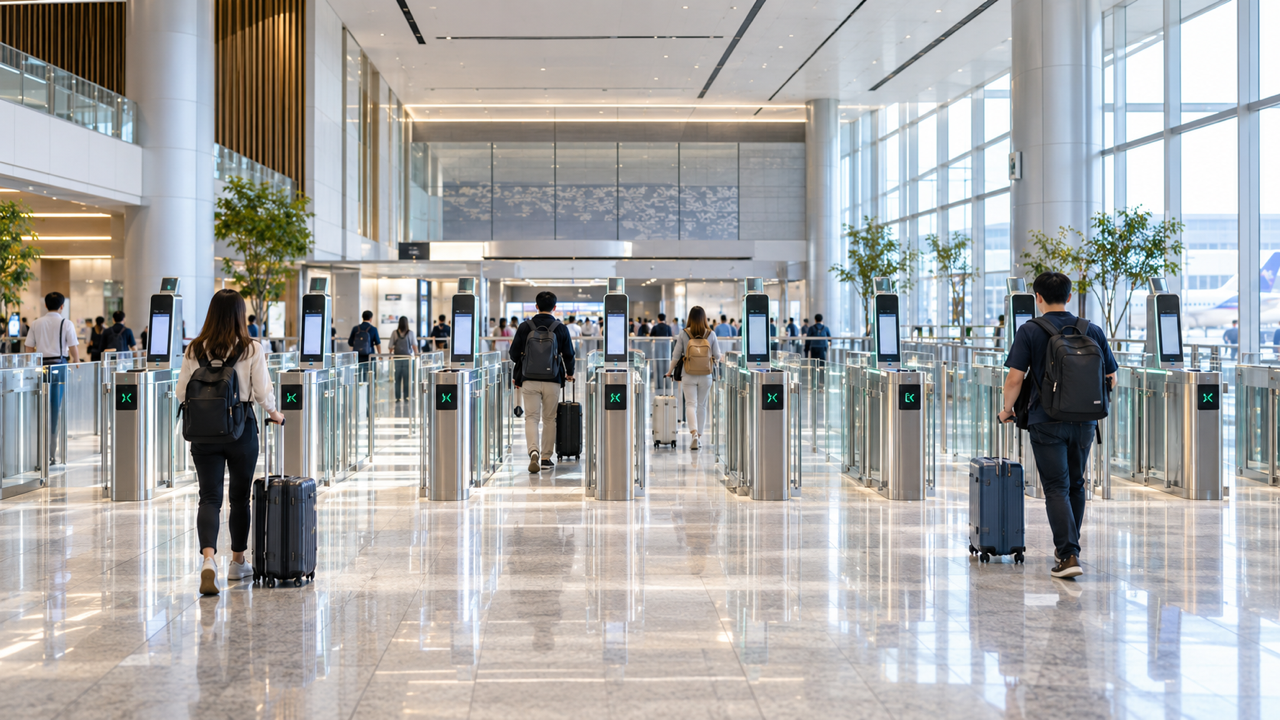
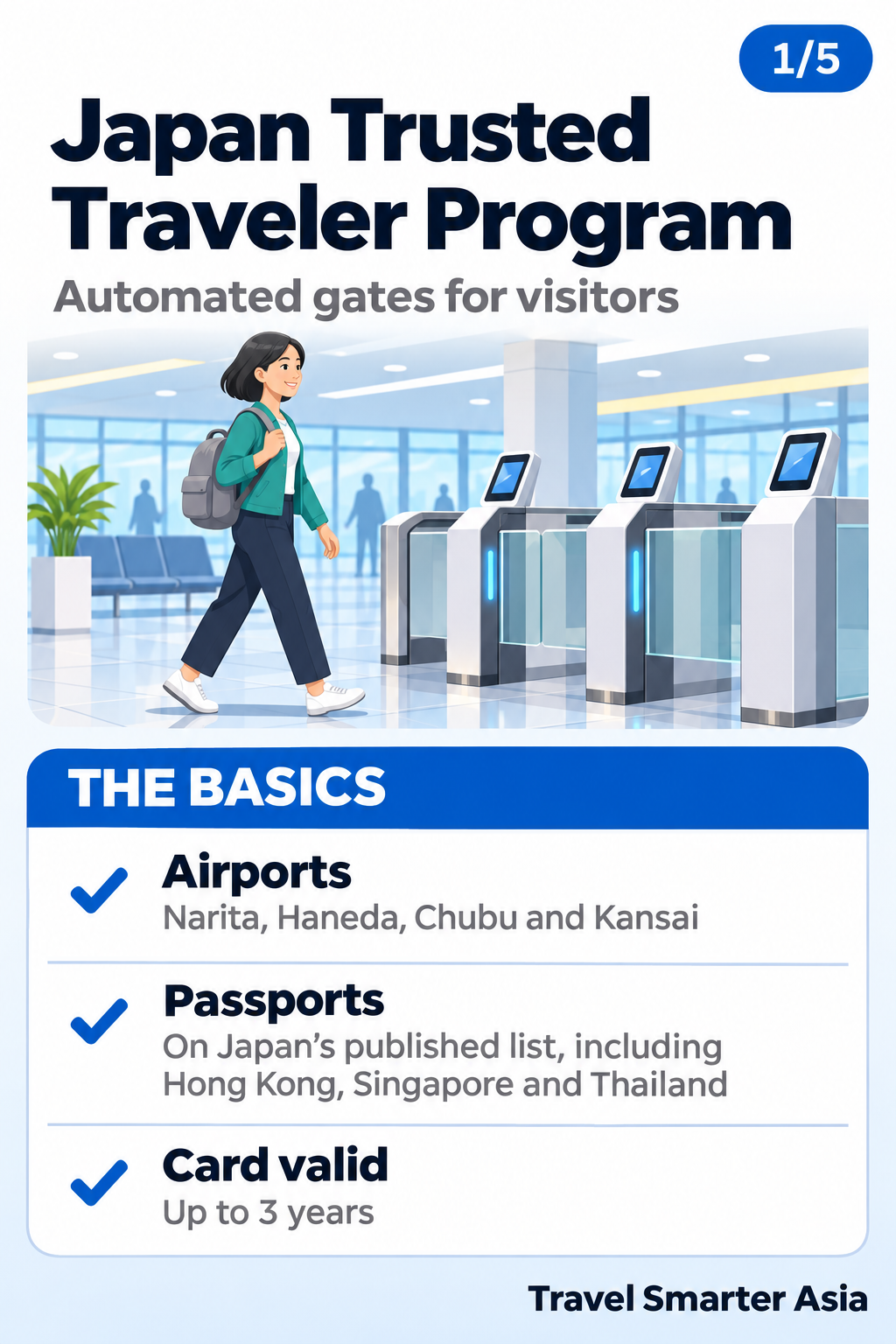
Japan’s Trusted Traveler Program (TTP) gives eligible short-stay visitors a card that opens the automated immigration gates at four airports. The Immigration Services Agency (ISA) runs it and publishes the rules mostly in Japanese.
You cannot get the card before you travel. Registration has an online step and an in-person step at a Japanese airport, so the first trip is the one where you queue as usual.
Who can register
Every applicant needs all of these:
- A passport from a country or region on the ISA’s list of visa-free issuers.
- At least one entry into Japan in the year before the day you appear at the registration desk if you are a business traveller or a family member, and at least two if you are a tourist or a US Global Entry member. The entry you register on counts.
- No deportation or departure order in your past, no fine or heavier sentence in Japan or abroad, and no ground for refusal of landing.
- Fingerprints from both hands.
- A short stay in mind: business, tourism or visiting relatives.
The list has nine Asian entries: Indonesia, Singapore, Thailand, Malaysia, Brunei, South Korea, Taiwan, Hong Kong and Macao. It also covers the United States, Canada, Australia, New Zealand, the UAE, Israel, Qatar, Türkiye and most of Europe, plus parts of Latin America and Africa. Mainland China, India, the Philippines and Vietnam are not on it. Some passports from listed places are still excluded, so run ISA’s online pre-check. Indonesian and UAE passports must hold a visa-exemption registration or travel authorisation from an embassy. For the United Kingdom, only British citizens qualify, and a British National (Overseas) passport also needs a copy of the Hong Kong ID card page.
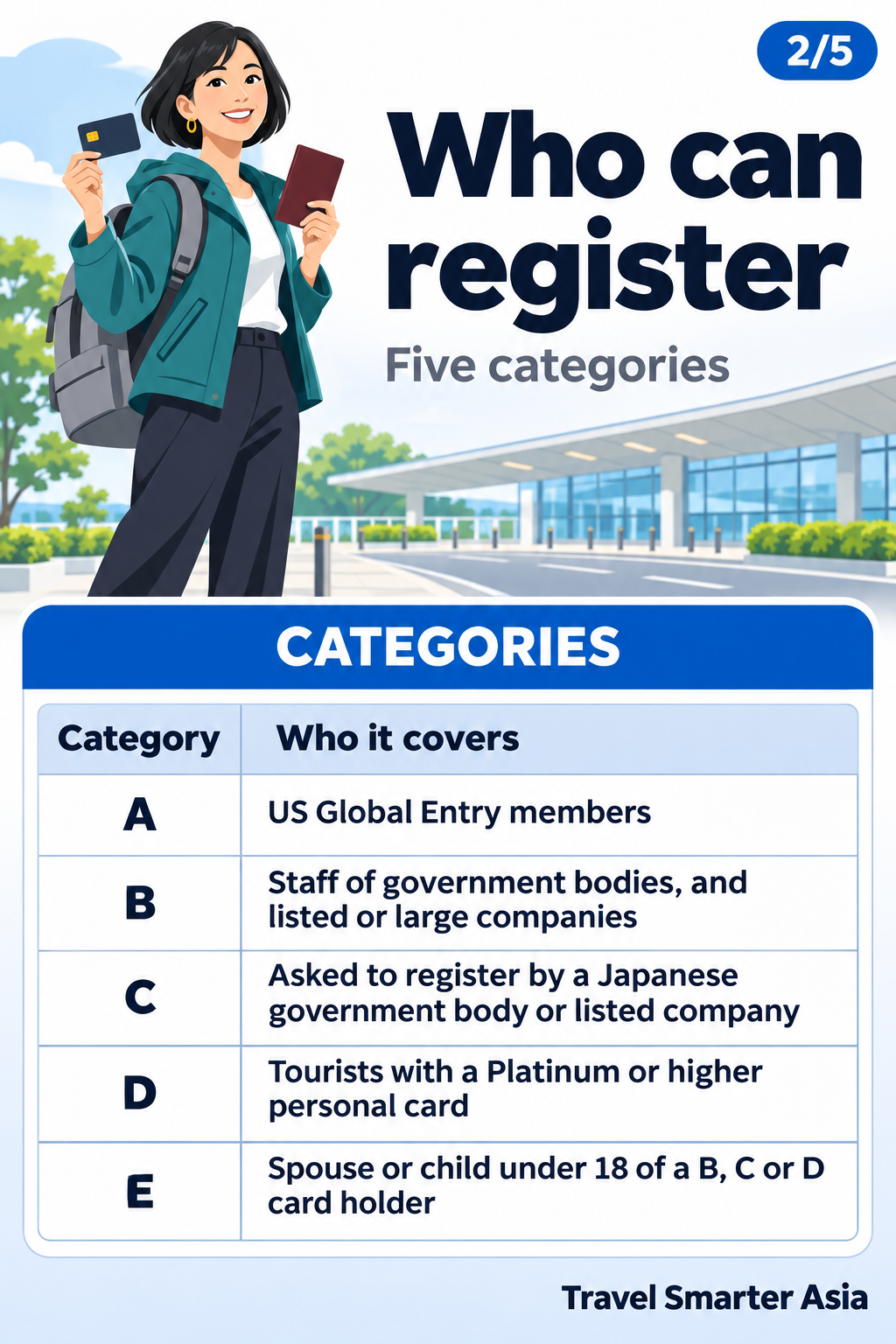
The five categories
| Category | Who it covers |
|---|---|
| A | US citizens enrolled in Global Entry |
| B | Officers and full-time staff of a government body, an international organisation, a listed company or a company with at least 500 million yen in capital (ISA’s pre-check gives the exact test) |
| C | People a Japanese government body or listed company asks to register because their work needs repeated entry |
| D | Tourists holding a personal card at Platinum rank or above on Visa, Mastercard, American Express, Diners Club, Discover, JCB or UnionPay |
| E | The spouse or unmarried child under 18 of a card holder in B, C or D |
Corporate cards do not count for D. A card that ranks Platinum or above but does not print the word should still be submitted, and ISA will assess it. Parents of a card holder are not covered by E. Adopted children are.
What it costs
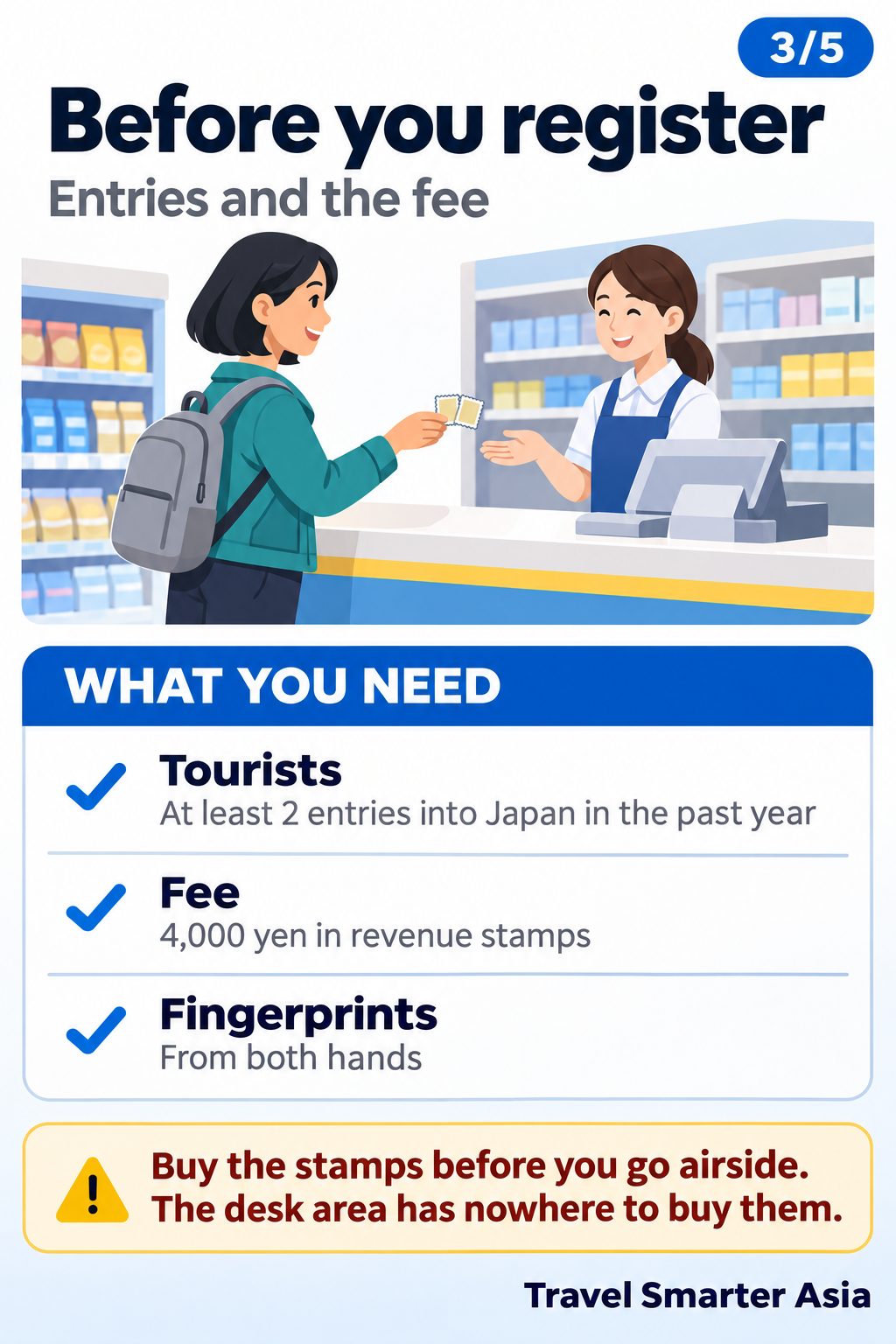
The issue fee is 4,000 yen, paid in revenue stamps. That has applied since 1 April 2025; the earlier fee was 2,200 yen. Credit cards are not accepted. Post offices and convenience stores in Japan sell stamps.
The registration desks inside the departure immigration areas cannot register you without stamps, and ISA says that area has nowhere to buy them. Buy them before you go airside. A replacement card is 2,000 yen.
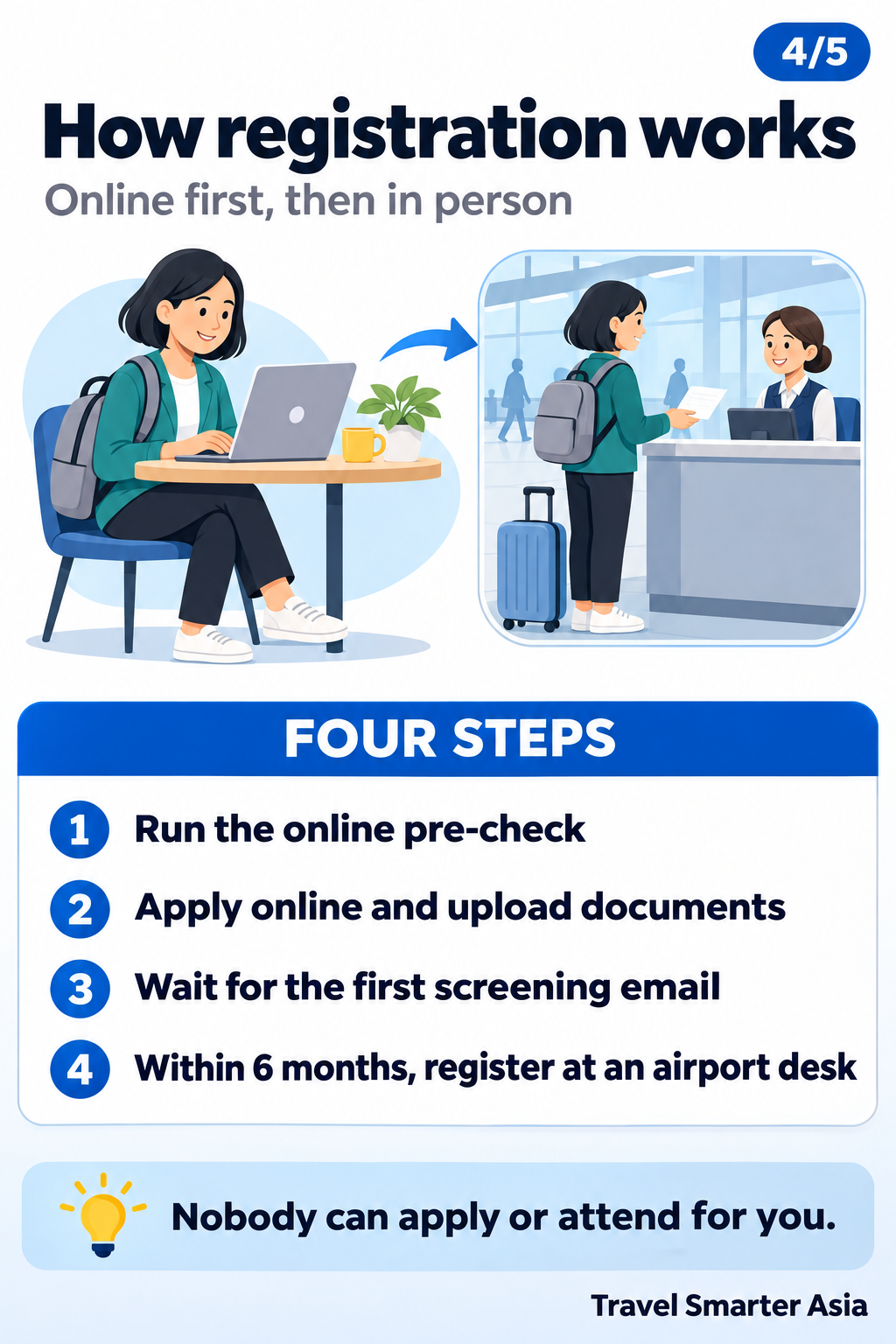
How registration works
- Pre-check. ISA’s website suggests which category you might fit and which documents it needs. It is not an assessment.
- Online application. Create an account on ISA’s registered-user system, which displays in Japanese, English, Korean and both Chinese scripts, though entries are typed in English. Upload a photo (JPEG) and your supporting documents (PDF), with an English or Japanese translation of anything in another language. You can also apply in person at a desk, which still needs a second visit.
- First screening. ISA emails the result. Its pages do not say how long this takes.
- Second screening, within six months of that email. Clear immigration the usual way, then go to a registration desk with the original documents. ISA takes your fingerprints and photo and, if you are approved, issues the card on the spot once you hand over the stamps. Tourists and Global Entry applicants must still show two entries in the past year at this point.
Nobody can apply or attend for you, and a parent cannot apply for a child. The desks in the departure halls run from 08:00 or 09:00 to 16:00, except Haneda Terminal 3 (to 17:00) and Chubu Terminal 1 (08:30 to 11:30, closed on weekends, public holidays and 29 December to 3 January). Leave time before your flight, because ISA warns that registration can take a while.
Using the card
The card is valid for three years from issue, or until your passport expires if that comes first. A renewed passport needs a new registration, and the old card stops working.
The gates are at Narita Terminal 1 and 2, Haneda Terminal 3, Chubu Terminal 1 and Kansai, and not at Narita Terminal 3, Haneda Terminal 2 international or Chubu Terminal 2. You scan your passport, put the card in the printer slot, confirm your arrival-card details, give two fingerprints and have your face photographed. The gate returns the card with the entry recorded on its back. You can use the gates from the departure of the trip on which you registered, and you should enter your arrival-card details in the registered-user system before each trip, or type them at the gate.
What changes at the border:
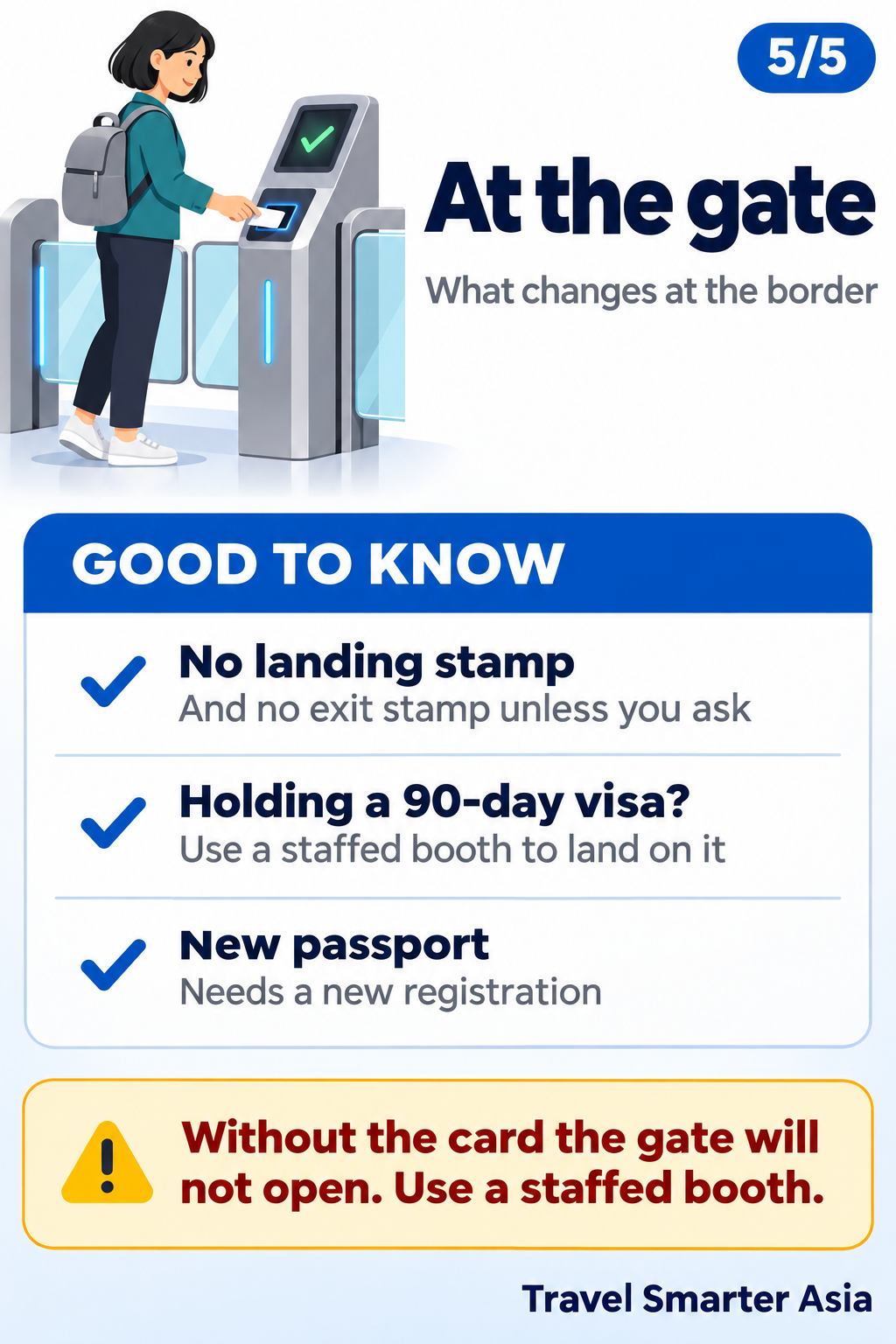
- Your passport gets no landing stamp, and no exit stamp unless you ask for one at the time. A stamp cannot be added later. The JR Pass guide explains why the missing stamp matters for rail passes.
- If your passport’s visa-free stay is 30 or 15 days, the gate grants that stay even if you hold a 90-day visa. To land on the visa, use a staffed booth.
- Without the card the gate will not open for you, even if you are registered. Use a staffed booth.
- You still need your passport to enter Japan. Inside Japan, ISA says to carry the card, and that it replaces carrying the passport.
Fingerprints of children up to about 12 are often not stable enough to register or to match at the gate. A card issued as a spouse or child stops working after a divorce or at adulthood unless you meet another category.
The card covers immigration only. Visit Japan Web handles the arrival forms and Japan’s customs e-Gate is a separate step.